 By Sherman Hu · Updated November 19, 2026 · 13 min read

In carpentry, the business that wins is the one whose finished work a homeowner sees before they call: on the map with a few honest reviews, with photos of the exact kind of project they want, and a clear answer to “do you do small jobs?” The bar is low right now. In our 3-city sample, the top map results for “carpenter” had a median of one review.
How Customers Find A Carpentry Business
Most carpentry work is planned, not urgent. A homeowner wants crown molding before the holidays, a built-in bookcase beside the fireplace, a stair rebuilt before a sale, or a rotted deck board replaced before summer. They look at photos, ask friends, search, and call two or three people for a price.
“Carpenter” draws about 165,000 US searches a month. One warning about that number: the word is shared. In our related-search data, the top phrases with “carpenter” were about a pop singer, a film director, and carpenter bees and ants. That matters for ads (more below) and for your pages: say “finish carpenter,” “trim carpentry” or “custom built-ins” plus your town, so Google and the reader know which carpenter you are.
The 12-month trend runs high in winter and early fall and dips in early summer. Winter is indoor season: trim, doors, built-ins and closets. Spring and summer bring deck and porch work. Plan your posts and photo uploads around the work people book next, not the work you finished last.
The Project Planner
Wants a built-in, a closet system, new trim or a stair remodel. Looks at photos first, compares two or three quotes, and books weeks ahead.
The Repair Caller
A sagging door, a broken stair tread, a soft deck board. Searches “handyman near me” as often as “carpenter”, and wants someone this week.
The Trade Referral
Remodelers, general contractors, interior designers, painters and real estate agents who need a finish carpenter they trust to show up and leave clean edges.
The overlap with handyman and remodeling searches shapes the whole plan. “Handyman near me” draws about 110,000 US searches a month and “handyman services” about 40,500. Some of those searchers have a carpentry job and do not know the word to use. At the other end, a homeowner planning a kitchen calls a remodeler, who then hires a finish carpenter. Decide where you sit. If you take small repairs, say so and give them a page. If your minimum is a full day, say that too, so you stop paying for calls you turn away.
Google Business Profile Setup For Carpentry
Google's guidelines say to use as few categories as possible to describe your core business, and to make each one as specific as possible. Choose the most specific category Google offers for carpentry or finish carpentry as your primary. Add a second category only for work that makes up a real share of your jobs, such as decks or cabinets.
| Profile Field | What To Enter For A Carpentry Business |
|---|---|
| Business name | Your real-world name. Google says including unnecessary information in your business name is not permitted, so no “Best Carpenter Near Me” added to it. |
| Address and service area | You work at the customer's home. Google says service-area businesses hide their address, and that a service area extends no farther than about 2 hours of driving from your base. |
| Services | Trim and baseboard, crown molding, wainscoting, interior doors, built-ins and shelving, closets, stairs and railings, decks and porches, wood rot repair, small repairs if you take them. |
| Description | The project types you are known for, the towns you serve, your license number where your state issues one, your minimum job size, and whether you work with designers and contractors. |
| Photos | Finished projects first: a stair, a built-in wall, a mitered crown corner close up. Then work in progress and your shop. No house numbers or customers' faces. |
| Posts | One finished project a week with the town and the job type. Before winter: trim and built-ins. Before spring: deck repair and porch work. |
| Booking and messaging | A link to request an estimate with photo upload. Messaging only if someone answers the same day. |
Photos do the selling in this trade. A homeowner looking for a built-in wants to see a built-in, not a stock image of a tape measure. Upload new project photos every week, in sets: wide shot, detail shot, and the before photo. The Google Business Profile post planner keeps a weekly project post on schedule.
Reviews That Win The Map
This is the biggest opening in the plan. In our 3-city sample of Columbus, Tulsa and Spokane, the top 3 map results for “carpenter” had a median of 1 Google review. A carpenter who finishes three or four jobs a month and asks every customer passes that bar in weeks. The calculator at the top of this page shows your gap and what extra leads are worth at your job size.
The best moment to ask is the walk-through, when the customer runs a hand along the new trim or opens the built-in doors for the first time. Send the text that evening with your link from the Google review link generator. For past customers, a short note with a photo of their finished project works well: “Still enjoying the bookcase? An honest review helps other homeowners find us.”
The rules on asking. Google's policy bans reviews “paid for, directly or in kind,” bans offering discounts or free services in exchange for a review, and bans efforts to “selectively solicit positive reviews.” The FTC's Consumer Reviews and Testimonials Rule, in effect since October 21, 2024, allows courts to impose civil penalties for knowing violations, and bars incentives that require a review to be positive. Ask every customer, with no discount tied to the review.
Reviews that name the project and the town help the next buyer: “built-in bookcases in Clintonville,” “replaced our stair treads in Midtown.” Reply to each with the job type in your own words. For a complaint about a gap or a finish, say once what you did to fix it and invite a call.
Website Pages That Rank And Convert
Carpentry buyers shop with their eyes. Build the site around project types, each with a gallery of your own work, so a homeowner who wants a stair sees stairs and a designer who wants built-ins sees built-ins.
| Page | What It Must Answer | Photos To Show |
|---|---|---|
| Finish carpentry and trim | Baseboard, casing, crown, wainscoting, coffered ceilings; paint-grade vs stain-grade; how you price it. | Mitered corners close up, full rooms |
| Built-ins and cabinetry | Bookcases, mudroom lockers, window seats, closets; shop-built vs site-built; lead time. | Finished walls, open drawers, details |
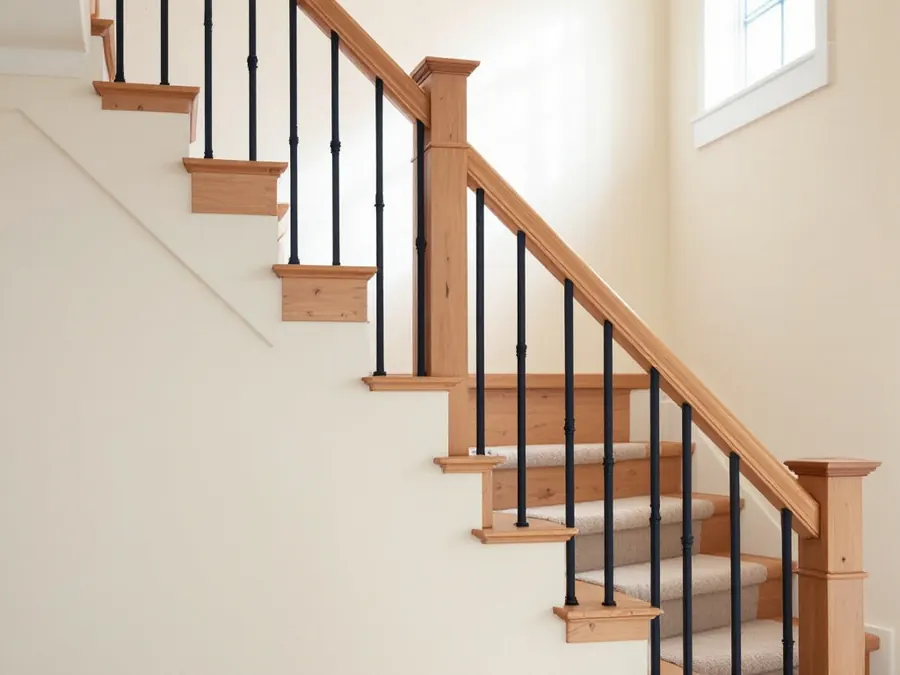
| Stairs and railings | Tread and riser replacement, new railings and balusters, code questions you handle with the permit office. | Before and after of the same stair |
| Decks and porches | Board and railing repair, rebuilds, rot repair, materials you use, permits. | Repaired boards, finished decks |
| Repairs and small jobs | Your minimum job size, doors that stick, broken treads, rotted trim, how to book. | Quick fixes, before and after |
| Cost guide | Your hourly or day rate, ranges by project type, what changes the price. | One project with its price range |
| Area pages | Real local detail: housing age and styles, common trim profiles, permit offices. | Projects in that town |
On the cost page, quote a labelled outside figure and your own ranges. Fixr's cost guide, updated January 2025, puts the national average carpenter rate at $90 an hour (most between $75 and $125), trim labor at $1.30 to $4.50 a linear foot, custom shelving at $250 to $450 a unit and a custom closet at $2,500 to $5,000. Present those as a third-party estimate, then show what your price includes: materials, finishing, cleanup.
Write a caption under each photo with the project, the wood species or material, and the town. Captions are text, so search engines and AI assistants read them. A gallery with no words tells them little.
For structured data, schema.org has no carpenter type. HomeAndConstructionBusiness covers businesses that provide services around homes and buildings, with GeneralContractor as one listed subtype. The local business schema generator builds the JSON-LD. The service area page planner keeps each town page specific instead of copied.

Niche Directories And Citations
Citations are listings of your name, phone and service area on other sites. For carpentry, the ones that matter are the ones homeowners and trade partners check before they call.
State License Lookups
Where your state licenses carpentry, its license lookup is the record buyers check. California, for example, lets anyone check a license number online. Match your name and phone exactly.
Deck Builder Directories
If decks are a real part of your work, the North American Deck and Railing Association runs a “Find a Builder” directory for homeowners and says member builders follow a code of ethics.
Bing Places And Apple
Claim Bing Places for Business and your Apple Maps listing through Apple Business so Bing, Copilot and Apple Maps show the same facts as Google.
Trade Partners
Remodelers, interior designers, home builders associations and real estate offices that keep vendor lists.
Check your listings with the NAP consistency checker once a quarter. Fix any that show an old phone number or an old business name.
Showing Up In AI Answers
Homeowners ask ChatGPT, Gemini, Copilot and Perplexity questions such as “who builds custom built-ins in Tulsa,” “carpenter or handyman for stair repair,” and “how much does crown molding cost per foot.” Assistants answer with sources, and a local carpenter gets named when the facts about the business are clear and the same everywhere.
- Be crawlable. Google says there are “no additional requirements” to appear in AI Overviews or AI Mode: the page must be indexed and eligible to be shown with a snippet. OpenAI says sites opted out of OAI-SearchBot are not shown in ChatGPT search answers, so allow it in robots.txt.
- Name the project types. One page each for trim, built-ins, stairs and decks gives an assistant a clear match for each question.
- Put facts in text. Towns served, minimum job size, license number, lead time and price ranges belong in plain HTML, not only in photos or a PDF.
- Earn mentions. Reviews that name the project, designer and builder pages that credit your work, and license records give assistants third-party support for your own pages.
Run the AI visibility check each quarter to see whether assistants name you and describe your work correctly.
Ads Worth Testing
The panel above shows $13.98 a click, and the exact word “carpenter” runs $10.13. Handyman phrases cost about the same: $9.08 for “handyman near me”. At a $1,500 job, a few booked estimates a month pay for a small test, but only with careful negatives.
| Search | Cost Per Click | Who Is Searching |
|---|---|---|
| carpenter | $10.13 | Mixed: buyers, fans and pest searches |
| handyman near me | $9.08 | Ready to book a small job |
| local handyman | $10.24 | Ready to book, wants someone nearby |
| carpenter bees | $1.56 | Pest problem, add as a negative |
| carpenter ants | $1.61 | Pest problem, add as a negative |
Local Services Ads. Google's US category list, checked in November 2026, includes “Carpenters”. Google says these ads are “shown prominently in Google Search results” when people search for the services you offer, and that you pay only for leads related to your business, not for clicks. For the Carpenters category, Google's screening page lists business and owner background checks, business registration, general liability insurance, and state business and owner licenses “where applicable by local law”, each marked “select users only”. In plain terms: a pay-per-lead ad can sit above the map for your searches, and the checks you face depend on your state and account. Check eligibility and current requirements on Google's Local Services help pages before you budget for it.
Google Ads and Microsoft Ads. Bid on project phrases with your town: “finish carpenter,” “custom built-ins,” “stair railing installation.” Add negatives for bee, bees, ant, ants, beetle, singer and director names, Halloween, jobs, salary, school and tools. Send clicks to the matching project page, not the home page.
Lead platforms. Shared-lead sites sell the same request to several pros, so speed decides who wins it, and many requests are small jobs. Test one for a month with a tracked number and compare cost per signed job against your own ads and profile.
Turning Visits Into Calls Or Bookings
The conversion in carpentry is the booked estimate. Most buyers have photos of the space or a picture of what they want, so let them send it. Put a tap-to-call number in the header and a short form with photo upload on every project page.
- Answer or call back fast. Return missed calls within the hour with a text that says when you will call.
- Ask four questions: what project, what room or area, photos or measurements, and when they want it done.
- Qualify on size. If the job is under your minimum, say so politely and point them to a handyman you trust. They remember the honesty.
- Send a written estimate within two days, with materials, finish, schedule and payment terms.
- Follow up twice: at three days and at ten. Planned projects get decided slowly.
Use the lead value calculator to see what one extra booked estimate is worth at your close rate before you set an ad budget. If you want this plan set up and run for you, Sherman Hu does that through local SEO and Google Maps work.
Rules And Risks In Carpentry Marketing
Contractor licensing thresholds vary by state and city. Some states license carpentry as its own trade, some license it as home improvement, and some exempt small jobs under a dollar limit. The examples below come from official pages. It is information, not legal advice: check your own state and city before you advertise there.
| Source | What It Says |
|---|---|
| California Contractors State License Board | Has a C-6 “Cabinet, Millwork and Finish Carpentry” license for contractors who make and install cabinets, doors, trims and other finish carpentry. Framing and rough carpentry fall under C-5. |
| California CSLB, AB 2622 press release | Since January 1, 2025, an unlicensed person can do projects under $1,000 (labor, materials and all other items) only with no hired workers and no building permit, and ads must state the person is not licensed. |
| Arizona Revised Statutes 32-1121 | Exempts work under $1,000 on one project only if it is “of a casual or minor nature,” needs no local building permit, is not split to evade the law, and ads include the words “not a licensed contractor.” |
| Maryland Home Improvement Commission | Lists carpentry, cabinets, decks, porches and stairs among the “type of work usually required to be licensed” (the list is not all inclusive). |
What this means for your marketing. Where your state licenses this work, publish the number on your site and profile. If you work under a small-job exemption, the ad rules in California and Arizona require you to say you are not licensed, and the dollar limit covers the whole project, not one visit. Do not advertise deck rebuilds or stair work that needs a permit unless you hold the license your state requires.
Your 90-Day Plan
Work down this list in order. The review and photo steps pay off first, because the bar on the map is so low. Your ticks save on this device.
Searches Your Customers Use
Real US Google searches for carpentry, with monthly volume and what advertisers pay per click. Build a page or a section for each group of searches.
| Search | Searches a month | Cost per click |
|---|---|---|
| carpenter | 165,000 | $10.13 |
| handyman near me | 110,000 | $9.08 |
| handyman services | 40,500 | $8.18 |
| handyman contractors near me | 22,200 | $6.91 |
| handyman service near me | 22,200 | $6.66 |
| local handyman | 6,600 | $10.24 |
| local handyman services | 4,400 | $9.64 |
Free Tools For This Plan
 Free GeneratorGoogle Review Link And QR Code GeneratorMake the link that opens your Google review box, plus a QR code and a printable counter card.
 Free GeneratorLocal Business Schema GeneratorFill in a form, get valid LocalBusiness JSON-LD to paste into your site.
 Free PlannerGoogle Business Profile Post PlannerA year of post ideas by month, a post drafter with a character counter, and weekly reminders.
 Free PlannerService Area Page PlannerList your services and towns, get a page plan that avoids thin copy-and-paste pages.
Questions Carpentry Owners Ask
How many Google reviews does a carpenter need to show on the map?
There is no fixed number. In our 3-city sample of Columbus, Tulsa and Spokane, the top 3 map results for “carpenter” had a median of 1 Google review. That is a very low bar. Ten honest reviews that name the project and the town put you ahead of most carpenters in a sample like that. Use the calculator at the top of this page to see your own numbers.
Can carpenters use Google Local Services Ads?
Yes. Google's US Local Services Ads list includes “Carpenters” as of November 2026. You pay per lead, not per click. Google lists background, business registration, general liability insurance and state license checks for the category, each marked “select users only”, with licenses required where local law applies. Check eligibility for your area on Google's Local Services help pages.
Do I need a license to advertise carpentry work?
It depends on your state. California's Contractors State License Board has a C-6 license for cabinet, millwork and finish carpentry, and exempts only jobs under $1,000 with no permit and no hired workers. Maryland's Home Improvement Commission lists carpentry, decks and stairs among work that usually needs its license. Check your own state and city before you advertise.
Do I compete with handymen and remodelers in search?
Yes. Some homeowners with a small carpentry job search “handyman near me” (about 110,000 US searches a month) rather than “carpenter”. Remodelers win the bigger kitchen and bath work. Say plainly on your site which jobs you take, from door hanging to full built-ins, so both kinds of searcher know you fit.
What do I put on a carpentry website?
One page per project type you want more of: trim and crown molding, built-ins and shelving, stairs and railings, decks and porches, and repairs. Each page shows real photos of finished work, what the job includes, typical price ranges, and your service area. Add a license page if your state licenses carpentry, and a short quote form.
What schema type fits a carpentry business?
Schema.org has no carpenter type. HomeAndConstructionBusiness covers businesses that provide services around homes and buildings, and GeneralContractor is one of its listed subtypes. Use HomeAndConstructionBusiness with your name, phone, service area and services filled in. The free schema generator builds the code.
Sources And How We Measured
Search numbers come from DataForSEO (Google Ads data, United States) on November 19, 2026: monthly searches and cost per click for “carpenter” and related searches, plus a 12-month trend. The map figures come from the top 3 Google Maps results for the main search in Columbus OH, Tulsa OK and Spokane WA: a sample, not a national average. “Agencies searching for this niche” counts searches such as “carpentry marketing” and “SEO for carpenters” per 1,000 customer searches (0.24 here).
The calculator's default job value of $1,500 is an example: about two working days (16 hours) at Fixr's published national average carpenter rate of $90 an hour, which comes to $1,440, rounded. The related-search list for “carpenter” in our keyword data was dominated by a singer, a film director and carpenter bees and ants, so the searches table pairs “carpenter” with the handyman searches that overlap small carpentry jobs. Licensing examples come from official California, Arizona and Maryland pages listed below.
- Google Local Services Help, Getting started with Local Services Ads, United States (category list) (Nov 2026). support.google.com/localservices/answer/6224841?hl=en&co=GENIE.CountryCode%3DUS
- Google Local Services Help, Business screening and verification requirements, United States (Nov 2026). support.google.com/localservices/answer/12174778?hl=en&co=GENIE.CountryCode%3DUS
- Google Business Profile Help, Guidelines for representing your business (Nov 2026). support.google.com/business/answer/3038177?hl=en
- Google Maps User Contributed Content Policy (fake engagement) (Nov 2026). support.google.com/contributionpolicy/answer/7400114?hl=en
- Google Search Central, AI features and your website (Nov 2026). developers.google.com/search/docs/appearance/ai-features
- OpenAI, Overview of OpenAI crawlers (OAI-SearchBot) (Nov 2026). developers.openai.com/api/docs/bots
- FTC, Consumer Reviews and Testimonials Rule: Questions and Answers (Nov 2026). www.ftc.gov/business-guidance/resources/consumer-reviews-testimonials-rule-quest...
- California CSLB, C-6 Cabinet, Millwork and Finish Carpentry classification (Nov 2026). www.cslb.ca.gov/about_us/library/licensing_classifications/Licensing_Classificat...
- California CSLB, Handyperson Exemption to Increase to $1,000 in 2025 (press release, Dec 30, 2024) (Nov 2026). www.cslb.ca.gov/Resources/PressReleases/2024/AB2622.FINAL.pdf
- Arizona Revised Statutes 32-1121, Persons not required to be licensed (Nov 2026). www.azleg.gov/ars/32/01121.htm
- Maryland Home Improvement Commission, What is Home Improvement? (Nov 2026). labor.maryland.gov/license/mhic/mhicwhatishi.shtml
- North American Deck and Railing Association (Find a Builder) (Nov 2026). www.nadra.org/
- Schema.org, HomeAndConstructionBusiness (Nov 2026). schema.org/HomeAndConstructionBusiness
- Fixr, Carpenter Cost (third-party cost guide, updated January 31, 2025) (Nov 2026). www.fixr.com/costs/carpenter