 By Sherman Hu · Updated November 19, 2026 · 14 min read
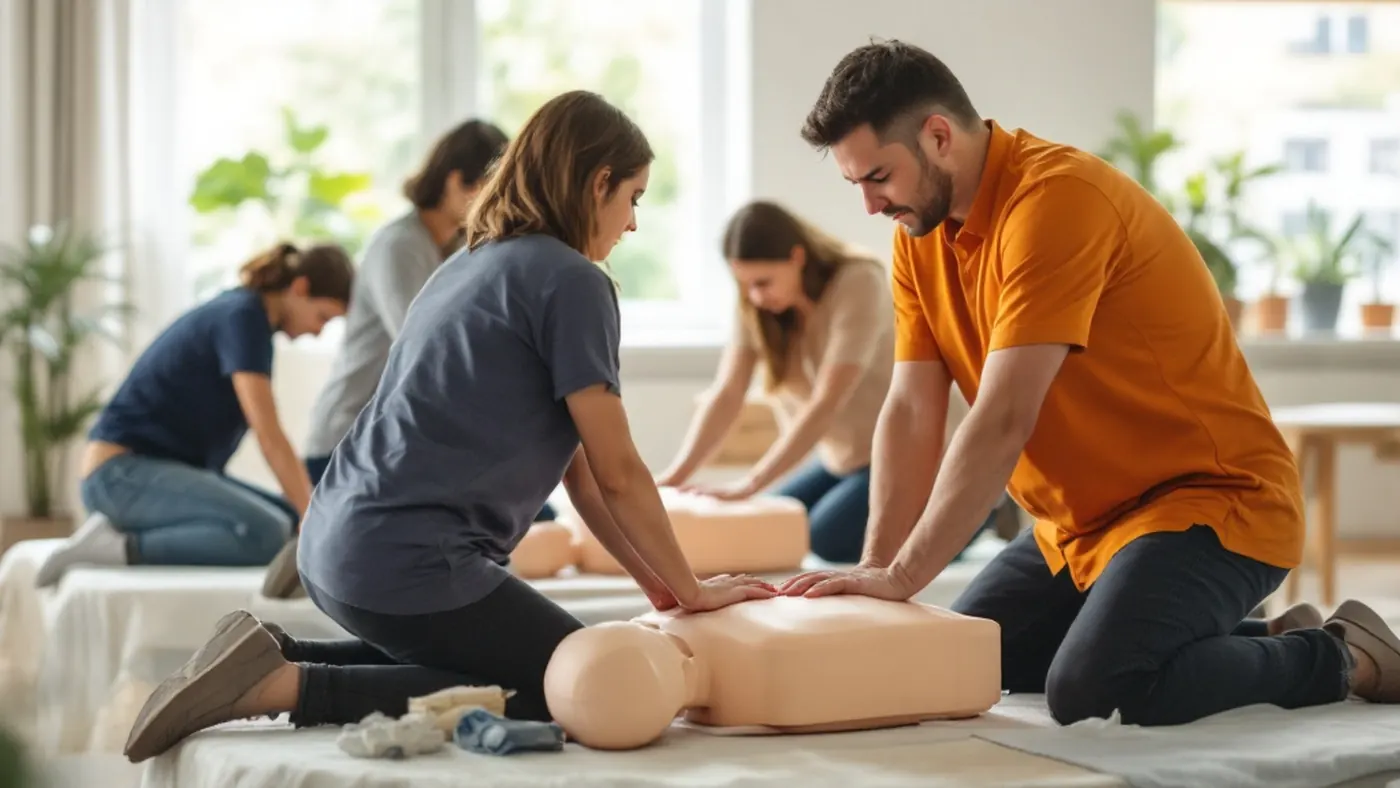
In CPR and first aid training, the deadline chooses the moment and the searcher chooses the class. A nurse with a BLS card about to expire, a new hire told to get certified by Monday, an office manager who needs ten staff trained before an inspection: each one types “near me” and books the first provider that shows a date, a price and a card that their employer accepts. The providers that win show up on Google Maps, publish every class with online booking, and remind every student before the card runs out.
How Customers Find A CPR And First Aid Training Provider
The demand is built into the certificates. The American Heart Association says its BLS Provider Course is designed for healthcare professionals and trained first responders, and that students receive a course completion eCard valid for two years. The American Red Cross says CPR certification lasts 2 years after training. Every card you issue is a renewal due in 24 months, and the searches show it: “cpr renewal classes near me” sits in the same 90,500-a-month pool as “cpr classes near me”.
Workplace rules drive the second buyer. OSHA's general industry standard, 29 CFR 1910.151(b), says that in the absence of an infirmary, clinic or hospital in near proximity to the workplace, “a person or persons shall be adequately trained to render first aid.” The construction standard, 1926.50(c), asks for a person with a valid certificate in first-aid training from the U.S. Bureau of Mines, the American Red Cross, or equivalent training that can be verified by documentary evidence. That employer is buying for a group, often on site.
The two buyers want different things. The individual wants a class this week, close by, at a fair price, with the right card. The employer wants a provider who comes to them, trains everyone at once, handles the paperwork and invoices once. The searches split along those lines, plus a few groups with their own needs.
| Buyer | Typical searches (US a month) | What wins the booking |
|---|---|---|
| Individual who needs a card | “cpr certification classes near me” (90,500), “in person cpr classes near me” (2,400) | A dated class this week, a price, the card name and how fast it arrives |
| Healthcare worker or student | “bls cpr classes near me” (5,400), “american heart association cpr classes near me” (4,400) | The exact course name their employer or school asks for, renewal and full course options |
| Workplace responder | “cpr and first aid classes near me” (9,900), “cpr aed classes near me” (590) | A course with an in-person skills session, first aid and AED included |
| Parent, grandparent or caregiver | “infant cpr classes near me” (6,600) | Evening and weekend dates, an infant and child course, a calm small-group setting |
| Employer booking a group | No single search; they arrive through the searches above and Maps | An on-site training page, a group minimum, per-person pricing and a quote form |
Some searches are not paying buyers. “free cpr classes near me” draws about 14,800 searches a month, and searches for jobs and instructor courses come from people who want to teach, not learn. Keep those out of ads and out of your main pages.
Google Business Profile Setup For CPR And First Aid Training
Google says local results are mainly based on relevance, distance and popularity, and that businesses with complete and accurate information are more likely to show up. For a training provider, complete means every course, every format and the next class date visible from the profile.
Category
Google says to choose the fewest categories that describe the core business. Type “CPR” and “first aid” in the category field and pick the most specific match Google offers for CPR and first aid training as primary.
Services
Add each course as its own service with the exact name: BLS Provider, BLS renewal, Heartsaver First Aid CPR AED, Adult First Aid/CPR/AED, pediatric and infant CPR, on-site group training.
Location
A training room that receives students shows its address. Google's guidelines describe a hybrid business that serves customers at its address and also sets a service area. That fits a provider with a classroom that also trains on site.
Booking
Google's help pages let a profile carry booking and appointment links, with one set as preferred. Point it at your class schedule, not your home page.
Photos sell the room and the instructor: students on manikins, the AED trainer, the classroom with parking, an instructor at an employer's office. Keep student faces out of public photos unless they agreed. On hours, Google's guidelines tell businesses with varied hours, such as class schedules, not to list hours; if you staff an office at set times, list those customer-facing hours and send class times to the schedule page. Post every week with the next three class dates and one employer offer. The Google Business Profile post planner keeps that schedule simple. Then copy the same facts to Bing Places, which Microsoft relaunched at bing.com/forbusiness in October 2025 with an import from Google Business Profile.
Reviews That Win The Map
The top 3 map results in our 3-city sample had a median of 14 reviews. Google says more reviews and positive ratings can help a business's local ranking, and that prominence also draws on how many websites link to the business. Use the Win The Map calculator at the top of this page with your own class sizes. A provider that trains 30 students a month passes 14 within five months if one student in ten leaves a review.
Training has a natural moment for the ask: the end of class, when the student has just passed the skills check, and the message that delivers the eCard or certificate. Google says owners can ask customers to visit a Google link or scan a QR code. Put the QR code on the last slide and in the card email: “Your card is attached and valid for two years. If the class helped, a short Google review helps the next nurse or parent find a hands-on course.”
What Google prohibits: offering a discount on the renewal class or a free infant course in exchange for a review, asking only the students who seemed happy, and discouraging negative reviews. Ask every student the same way. For an employer group, ask the person who booked, not each employee in front of their manager.
Reply to every review and mention the course in general terms (“thanks for joining our Saturday BLS renewal”). Never name an employer or a student's workplace in a reply. The review request templates and the Google review link generator make the ask a two-minute job.
Website Pages That Rank And Convert
Searchers arrive with a course name and a deadline. A site that shows one page per course, with the schedule built in, answers both. A site with a single “Classes” page and a phone number sends them to the next result.
| Page | What it must answer |
|---|---|
| Class schedule | Every upcoming date, time, course, format, seats left, price and a book button. Updated weekly. |
| One page per course | Who the course is for, format (classroom or blended), length, skills check, card issued and validity, renewal rules |
| BLS for healthcare | Full course and renewal, what to bring, how fast the eCard arrives, which employers and schools accept it |
| On-site employer training | Courses offered on site, group minimum, equipment you bring, per-person price, card tracking, quote form |
| Infant and child CPR | Weekend and evening dates, small groups, what parents learn, whether a card is issued |
| Prices | Price per course, renewal price, group price, what is included (book, eCard, retest) |
| Credentials | Your affiliation stated exactly: the Training Center you align with, or your Licensed Training Provider status, and instructor credentials |
Put prices on the page. Superprof's 2026 cost guide, with prices checked on September 28, 2026, lists BLS Provider classes at $60 to $85, on-site Heartsaver First Aid CPR AED at $75 to $95 per person for groups of five or more, and Red Cross online-only courses at $37. Searchers compare those numbers, so a clear price per course, with what the card covers, removes the reason to call around.
Explain formats in plain words. The AHA says BLS comes in blended learning and classroom training, and that all BLS options result in the same BLS Course Completion eCard. Its HeartCode BLS blended course pairs online learning with a hands-on skills session. The Red Cross offers online, blended and in-person classes and says online-only formats do not qualify for workplace certification needs. A short table on each course page (format, time online, time in class, card) answers the question most callers ask.
For structured data, schema.org lists EducationalOrganization under Organization and under Place, not under LocalBusiness. A training provider with a classroom fits EducationalOrganization with its address and phone. Schema.org also has Course and CourseInstance types for the classes themselves. Google removed its course info structured data documentation on September 9, 2025, so this markup describes your classes clearly; it does not promise a special search result. Keep every fact in the markup identical to the page. The local business schema generator writes the base code.
Niche Directories And Citations
This niche has two national networks that also act as class finders. How each one works decides what you are allowed to say and where you are listed.
| Source | How it works | Your action |
|---|---|---|
| AHA Training Network | The AHA says its network includes Training Centers, Training Sites, TC Coordinators and instructors. Training Centers are responsible for all instructors, whether directly affiliated or through their Training Sites, and for the quality of all courses. | State your alignment exactly. Make sure your classes appear in the AHA class search your Training Center uses. |
| Red Cross Licensed Training Providers | The Red Cross says Licensed Training Providers are organizations and individuals licensed to independently use and teach Red Cross courses under a Licensed Training Provider Agreement, with no fee to set up the agreement and per-student fees for course content. | If you hold an agreement, ask about the Class Posting Service, which the Red Cross offers for a fee to list classes on redcross.org. |
| Other nationally recognized programs | OSHA's first-aid guide says training is offered by the AHA, the Red Cross, the National Safety Council and other nationally recognized and private organizations. | Name the program you teach on every course page. |
| Core listings | Google Business Profile, Bing Places, Apple Business Connect, Yelp, the BBB, your chamber of commerce. | Same name, address, phone and hours everywhere. |
Brand searches are real demand. “american heart association cpr classes near me” gets about 4,400 US searches a month and “red cross cpr classes near me” about 8,100. If you teach those courses, the course name belongs on your pages and in your profile services, stated as the course you teach, not as an endorsement.
Showing Up In AI Answers
People now ask ChatGPT, Gemini, Copilot, Perplexity or Google's AI Mode: “where can I get BLS certified this weekend near me”, “does my job accept online CPR”, “who does on-site first aid training for a small office near me”. An assistant names providers whose facts are stated clearly on their own pages and confirmed elsewhere, such as a class finder listing or a Business Profile.
The platforms publish their rules. Google says there are no additional requirements to appear in AI Overviews or AI Mode: a page has to be indexed and eligible to show with a snippet. It says no special schema.org markup or AI text files are needed, and its checklist includes matching structured data to the visible text and keeping Business Profile information up to date. OpenAI says OAI-SearchBot surfaces websites in ChatGPT search, and sites that opt out of it will not be shown in ChatGPT search answers.
What this means for a training provider: write course names, formats, card validity, prices and class dates on your pages in plain text, not only inside a booking widget or a PDF flyer. Check that robots.txt does not block OAI-SearchBot, Googlebot or Bingbot. Then ask ChatGPT your students' three questions once a month and note who it names.
Ads Worth Testing
Google's US Local Services Ads page lists “First aid training” under Wellness services. That makes Local Services Ads an option for training providers. Search ads are cheap in this niche, which makes testing easy.
| Search | Searches a month | Cost per click |
|---|---|---|
| cpr classes near me | 90,500 | $2.50 |
| cpr renewal classes near me | 90,500 | $2.78 |
| cpr & first aid classes near me | 9,900 | $3.23 |
| bls cpr classes near me | 5,400 | $4.10 |
| cpr aed classes near me | 590 | $3.61 |
| free cpr classes near me | 14,800 | $2.07 |
At $2 to $4 a click against a $60 to $95 class, a campaign pays when each ad goes straight to a page with dates and a book button. Run BLS ads to the BLS page and first aid ads to the workplace page. Add negative keywords for free, online-only if you do not sell it, jobs, instructor, and test answers. Raise budgets from September: the niche rose from 90,500 in August 2026 to 135,000 in October 2026.
Turning Visits Into Bookings And Renewals
The individual books online or not at all. The employer fills in a form or calls. The renewal happens only if you remind the student first. Build all three paths.
- Book in one step. A schedule with a book button on every date, card payment, and an instant confirmation with the address, parking and what to bring.
- Answer the employer within the hour. A quote form that asks for the course, number of staff, site address and preferred dates. A person who calls back the same day.
- Deliver the card fast. Send the eCard or certificate link the day of class, with the review link in the same message.
- Record the renewal date. Store every student's course and card date. The AHA and the Red Cross both put validity at two years.
- Remind before it expires. Send a renewal reminder 60 days before the card date with three upcoming renewal classes and a booking link.
- Turn employers into standing accounts. Track each employer's staff card dates and offer one on-site renewal day every year.
The renewal list is the core asset. A student who books once at $75 is a $75 customer. A student reminded every two years, and an employer whose new hires and renewals come to you, are worth far more than any single click. The Red Cross's own group training sets a billing minimum of 8 people, a useful reference point for your group pricing. Sherman Hu builds this kind of plan, profile and site for local owners through his local SEO service.
Rules And Risks In CPR And First Aid Training Marketing
Most of the risk in this niche is a claim that a card or course will be accepted when it will not. These official statements set the limits; check your own state rules and each employer's requirements.
OSHA approval
OSHA's first-aid best practices guide says OSHA does not teach first-aid courses or certify first-aid training courses for instructors or trainees. Do not advertise a course as “OSHA certified”.
Online-only courses
The Red Cross says online-only formats do not qualify for workplace certification needs; an in-person skills session is required. Label every online course so no buyer mistakes it for a workplace card.
OSHA CPR standards
OSHA's guide lists standards that require CPR training, including permit-required confined spaces (1910.146), logging (1910.266) and electric power work (1910.269). Name these only where they apply to the buyer.
Network rules
The AHA says Training Centers carry responsibility for the quality of courses from their aligned instructors and sites. Red Cross providers teach under their Licensed Training Provider Agreement. Follow your agreement on names, logos and card issue.
Advertise only what you deliver. Name the exact course, the program behind it, the card issued and its validity. Do not promise that a specific employer, school or licensing board will accept a card unless it has said so; send buyers to their employer, as the AHA does on its BLS page. Your Google Business Profile follows its own rules too: the real business name with no keywords added, an address only where students are received, and one profile per location.
Your 90-Day Plan
Work down the list in order. Ticks save on this device, so you can come back to it.
Searches Your Customers Use
Real US Google searches for cpr and first aid training, with monthly volume and what advertisers pay per click. Build a page or a section for each group of searches.
| Search | Searches a month | Cost per click |
|---|---|---|
| cpr classes near me | 90,500 | $2.5 |
| cpr certification classes near me | 90,500 | $2.78 |
| cpr renewal classes near me | 90,500 | $2.78 |
| cpr and first aid classes near me | 9,900 | $3.06 |
| cpr & first aid classes near me | 9,900 | $3.23 |
| infant cpr classes near me | 6,600 | $2.04 |
| bls cpr classes near me | 5,400 | $4.1 |
| american heart association cpr classes near me | 4,400 | $3.09 |
| in person cpr classes near me | 2,400 | $2.85 |
| cpr aed classes near me | 590 | $3.61 |
Free Tools For This Plan
 Free GeneratorGoogle Review Link And QR Code GeneratorMake the link that opens your Google review box, plus a QR code and a printable counter card.
 Free TemplatesReview Request Message WriterReady-to-send texts and emails that ask for a Google review, by industry and tone.
 Free GeneratorLocal Business Schema GeneratorFill in a form, get valid LocalBusiness JSON-LD to paste into your site.
 Free PlannerGoogle Business Profile Post PlannerA year of post ideas by month, a post drafter with a character counter, and weekly reminders.
Questions CPR And First Aid Training Owners Ask
Do I need to be an AHA Training Site or Red Cross Licensed Training Provider to rank?
No. Google ranks profiles, not affiliations. Buyers search for the course brand, though: “american heart association cpr classes near me” gets about 4,400 US searches a month. If you teach AHA courses through a Training Center or Training Site, or Red Cross courses under a Licensed Training Provider Agreement, name the exact course and affiliation on each class page.
How do I get more employer group bookings?
Give employers their own page. State the course options, the minimum group size, what you bring on site, how cards are issued and how the price works per person. Add a short quote form. The Red Cross sets a billing minimum of 8 people for its own group training, which shows buyers expect a minimum.
Do online-only courses hurt my business?
They change the question you answer. The Red Cross says its online-only formats do not qualify for workplace certification needs. AHA blended courses pair online learning with a hands-on skills session. Say plainly which of your courses include an in-person skills check and which employers accept them.
How do I handle searches for free CPR classes?
Free CPR searches are large: about 14,800 a month for “free cpr classes near me”. Most come from people who need no card. Add them as negative keywords in paid ads. If you run free community Hands-Only CPR sessions, give them their own page and offer certification classes as the next step.
How do I get students to leave reviews?
Ask every student the same way, at the end of class or in the message that delivers the eCard or certificate, with one link or QR code. Google prohibits incentives such as a discount on the next class for a review, and prohibits asking only students you expect to be happy.
Can I run Google Local Services Ads for CPR classes?
Google's US Local Services Ads page lists “First aid training” under Wellness services. Start the sign-up to see what Google asks for in your area. Search ads are open to all, with clicks on most CPR searches around $2 to $4.
Sources And How We Measured
Search numbers come from DataForSEO (Google Ads data, United States) on November 19, 2026: monthly searches and cost per click for “cpr classes near me” and related searches, plus a 12-month trend. The map figures come from the top 3 Google Maps results for the main search in Columbus OH, Tulsa OK and Spokane WA: a sample, not a national average. “Agencies searching for this niche” counts searches such as “cpr and first aid training marketing” and “SEO for CPR and first aid training providers” per 1,000 customer searches (0 here).
The searches in the body and the table come from the same DataForSEO pull (US, November 2026). Several phrasings of “cpr classes near me” carry the same 90,500 figure in that data, so treat them as one pool of demand, not separate totals. The calculator's default job value is an example: 8 learners at $75 each, the low end of the on-site Heartsaver First Aid CPR AED prices in Superprof's 2026 guide. Course prices are from that guide and vary by provider and city. OSHA, AHA and Red Cross statements are quoted from their own pages; they are information, not compliance advice.
- OSHA: 29 CFR 1910.151, Medical services and first aid (Nov 2026). www.osha.gov/laws-regs/regulations/standardnumber/1910/1910.151
- OSHA: 29 CFR 1926.50, Medical services and first aid (construction) (Nov 2026). www.osha.gov/laws-regs/regulations/standardnumber/1926/1926.50
- OSHA: Best Practices Guide, Fundamentals of a Workplace First-Aid Program (OSHA 3317, 2006) (Nov 2026). www.osha.gov/sites/default/files/publications/OSHA3317first-aid.pdf
- OSHA: Medical and First Aid overview (Nov 2026). www.osha.gov/medical-first-aid
- American Heart Association: Basic Life Support (BLS) course options (Nov 2026). cpr.heart.org/en/courses/basic-life-support-course-options
- American Heart Association: Become an AHA Training Center (PDF) (Nov 2026). cpr.heart.org/-/media/CPR-Files/Resources/Conf-Resources/Become-an-AHA-Training-...
- American Red Cross: CPR certification (Nov 2026). www.redcross.org/take-a-class/cpr/cpr-training/cpr-certification
- American Red Cross: Licensed Training Providers (Nov 2026). www.redcross.org/take-a-class/licensed-training-authorized-providers
- American Red Cross: Frequently Asked Questions for Organizations (PDF) (Nov 2026). www.redcross.org/content/dam/redcross/training-services/b2b/FAQs-for-Organizatio...
- Superprof: How much does a CPR class cost? (Mar 26, 2026; prices checked Sept 28, 2026) (Nov 2026). www.superprof.com/blog/cpr-classes-cost/
- Schema.org: EducationalOrganization (Nov 2026). schema.org/EducationalOrganization
- Schema.org: Course (Nov 2026). schema.org/Course
- Schema.org: CourseInstance (Nov 2026). schema.org/CourseInstance
- Google Search Central: Latest documentation updates (course info structured data removed, Sept 9, 2025) (Nov 2026). developers.google.com/search/updates
- Google Business Profile Help: Guidelines for representing your business on Google (Nov 2026). support.google.com/business/answer/3038177
- Google Business Profile Help: Tips to improve your local ranking on Google (Nov 2026). support.google.com/business/answer/7091
- Google Business Profile Help: Manage local business links (Nov 2026). support.google.com/business/answer/6218037
- Google Business Profile Help: Get reviews on your Business Profile (Nov 2026). support.google.com/business/answer/3474122
- Google Maps user contributed content policy: Prohibited and restricted content (fake engagement) (Nov 2026). support.google.com/contributionpolicy/answer/7400114
- Google Search Central: AI features and your website (Nov 2026). developers.google.com/search/docs/appearance/ai-features
- OpenAI: Overview of OpenAI crawlers (Nov 2026). developers.openai.com/api/docs/bots
- Search Engine Journal: Microsoft launches new Bing Places for Business (Oct 3, 2025) (Nov 2026). www.searchenginejournal.com/microsoft-launches-new-bing-places-for-business/5575...
- Google Business: Local Services Ads, eligible categories (US) (Nov 2026). business.google.com/us/ad-solutions/local-service-ads/